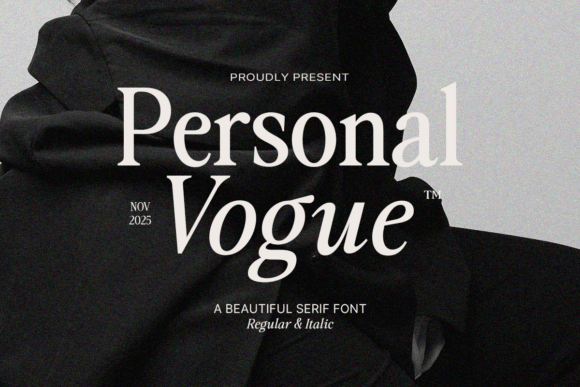
Personal Vogue: A Serif Typeface for Commanding Elegance
In the crowded landscape of digital typography, finding a serif font that balances historical gravitas with contemporary clarity can be a significant challenge. Many typefaces promise luxury but deliver either outdated forms or overly stylized designs that compromise readability. Personal Vogue enters this space as a high-contrast serif typeface, engineered to bridge the gap between classic editorial design and modern digital requirements. It is not merely a revival of the Bodoni style but a calculated refinement intended for high-stakes visual communication.
Anatomy and Design Philosophy
The defining characteristic of Personal Vogue is its dramatic contrast between thick and thin strokes. This high-contrast structure, reminiscent of the Didone classification, creates a strong visual rhythm that commands attention in headlines and display settings. However, unlike some historical revivals that can feel brittle on low-resolution screens, this typeface has been designed with a focus on digital rendering. The thin hairlines maintain their integrity without disappearing, ensuring the intended elegance translates across different devices.
The typeface features tall ascenders and beautifully curved terminals, which contribute to its "aspirational" feel. These vertical proportions give text a sense of upward movement and refinement. The family includes two essential styles: Personal Vogue Regular and Personal Vogue Italic. The italic style is particularly noteworthy; it is not simply a slanted version of the roman but features distinct, flowing letterforms. This design choice adds rhythmic movement to text blocks while maintaining the high legibility necessary for body copy. For designers, this means having a cohesive pair that can handle both the punch of a headline and the flow of a paragraph without feeling disjointed.
Practical Application and Performance
Evaluating a typeface requires looking beyond aesthetic appeal to its functional performance in real-world scenarios. Personal Vogue is engineered for specific use cases where prestige and clarity must coexist. Its structure makes it highly effective for:
- Fashion and Luxury Branding: The high-contrast strokes and elegant curves naturally align with the visual language of high-end fashion, cosmetics, and jewelry.
- Editorial Layouts: Whether for digital magazines or print spreads, the typeface provides the necessary hierarchy. The Regular weight holds up well in large subheadings, while the Italic can introduce pull quotes or captions with a distinct voice.
- Digital Interfaces: While serif fonts can sometimes struggle in UI design, Personal Vogue works well for landing pages, hero sections, and luxury e-commerce sites where brand perception is a priority over dense data display.
One of the practical strengths of Personal Vogue is its comprehensive glyph set. It includes extensive language support, which is a critical consideration for global brands. A typeface that fails to render accented characters or specific regional diacritics correctly can break the immersion of a design. By including these glyphs, Personal Vogue ensures consistency across multilingual campaigns, reducing the need for designers to source supplementary fonts for international projects.
Usability and Workflow Integration
From a workflow perspective, Personal Vogue offers a degree of versatility that simplifies the design process. Because the family is limited to two distinct styles—Regular and Italic—it encourages disciplined typographic hierarchy. Designers are less likely to fall into the trap of using too many weight variations, which can clutter a layout. Instead, the focus shifts to spacing, size, and color to create contrast.
The typeface performs reliably in desktop publishing software and web environments. When used in CSS, the font renders cleanly at large sizes, which is essential for its intended use in headlines and hero text. However, like all high-contrast serifs, it requires careful consideration at smaller sizes. While the italic is designed for legibility in body copy, extremely small text sizes (below 12px) on low-density screens may still present challenges due to the delicate thin strokes. Therefore, for dense, long-form reading on mobile devices, pairing it with a more robust sans-serif or a traditional text serif might be a more practical approach.
Target Audience and Strategic Fit
Who benefits most from integrating Personal Vogue into their toolkit? The typeface is best suited for professionals whose work revolves around visual storytelling and brand positioning. This includes:
- Brand Designers: For those crafting identities for luxury goods, boutique hotels, or high-end service providers, Personal Vogue offers a ready-made voice of sophistication.
- Content Creators and Publishers: Bloggers and digital publishers in the lifestyle, beauty, or architecture niches can use the typeface to elevate their visual presentation, making their content feel more curated and authoritative.
- Marketing Professionals: In advertising, where capturing attention in a split second is crucial, the striking contrast of the typeface ensures that headlines are noticed and remembered.
It is less suitable for projects requiring a "friendly" or "approachable" tone, such as children's education or casual community blogs. The inherent formality of Personal Vogue would feel out of place in those contexts. Its value lies in its ability to convey exclusivity and taste.
Conclusion: A Tool for Visual Authority
Personal Vogue is a specialized tool designed for specific, high-impact applications. It does not attempt to be a universal workhorse like Helvetica or Roboto. Instead, it excels as a display typeface that injects immediate sophistication into a project. Its thoughtful design, characterized by high contrast, elegant italics, and comprehensive language support, makes it a reliable asset for designers working in the luxury and editorial sectors. For those seeking to convey a sense of prestige and refined taste through typography, Personal Vogue offers a compelling and well-executed solution.