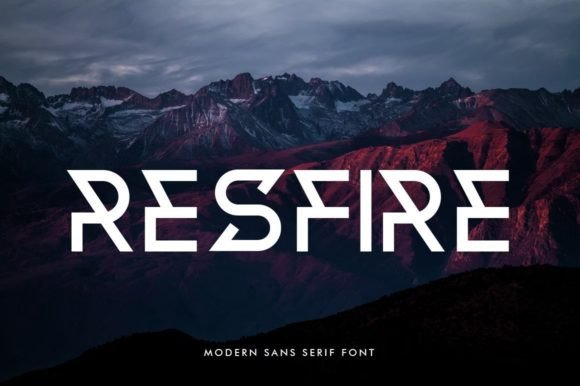
Decoding Resfire: The Sans-Serif Font Shaping Modern Visual Identity
In the ever-evolving landscape of digital design and typography, the selection of a typeface is far more than a mere aesthetic choice; it is a foundational decision that communicates brand personality, ensures readability, and defines the visual tone of an entire project. Among the vast library of available fonts, sans-serifs have long dominated the modern design ethos, prized for their clean lines and versatility. However, within this category, specific typefaces emerge that push the boundaries of conventional design. Resfire represents a significant evolution in this space, offering a unique blend of futuristic geometry and practical application that is rapidly becoming a staple for designers aiming to create a contemporary, cutting-edge visual language.
The Anatomy of a Futuristic Typeface
Understanding the appeal of Resfire requires a closer look at its structural composition. While many sans-serif fonts adhere strictly to uniform stroke widths and predictable curves, Resfire introduces subtle complexities that distinguish it from standard options like Helvetica or Arial. The defining characteristic of this font lies in its lowercase letters. Unlike traditional sans-serifs where lowercase characters often mimic smaller versions of their uppercase counterparts, Resfire’s lowercase set features distinct, stylized terminals and geometric cuts that give the text a rhythmic, almost kinetic energy.
This structural uniqueness ensures that even in dense blocks of text, the typography retains a sense of movement and innovation. The font avoids the sterile rigidity often associated with "tech" typefaces. Instead, it balances sharpness with readability, making it a versatile tool for both display and functional text. For designers, this means they can maintain a consistent futuristic theme without sacrificing the user experience, a critical factor in modern interface design.
Primary Applications: Beyond Standard Typography
While Resfire is fully capable of handling body text, its true potential is often realized in high-impact design scenarios. The font’s distinctive character shapes make it particularly effective in environments where branding needs to stand out instantly.
Crafting Iconic Logotypes
The most prominent application for Resfire is in the creation of logotypes. A logotype, or wordmark, relies entirely on the visual appeal of the letters themselves to represent a brand. Because Resfire’s lowercase letters possess such unique silhouettes, they allow for the creation of logos that are immediately recognizable and memorable. For a startup in the technology, gaming, or automotive sectors, using Resfire can instantly convey a sense of forward-thinking innovation. The font does the heavy lifting of "branding," allowing designers to focus on spacing and color without needing to heavily manipulate the letterforms.
User Interface and Digital Experience
In the realm of UI/UX design, typography must be legible across various screen resolutions while maintaining the product's personality. Resfire excels here because its unique features are most apparent in larger headings and buttons, areas where user attention is focused. When used for navigation menus or dashboard headers, it provides a sleek, professional look that elevates the entire digital product. It moves the interface away from the "generic app" feel, offering a bespoke atmosphere that users subconsciously associate with quality and modernity.
Strategic Advantages for Brand Identity
Adopting a typeface like Resfire is a strategic decision that offers several tangible benefits for business owners and creative professionals. The visual psychology of typography suggests that rounded, soft fonts imply friendliness, while angular, sharp fonts imply efficiency and precision. Resfire leans toward the latter, making it an ideal choice for brands that want to project competence and technological prowess.
- Differentiation: In saturated markets, visual blending is a risk. Resfire’s unique lowercase anatomy ensures a brand stands apart from competitors using overused default fonts.
- Scalability: The clean vector nature of Resfire ensures that logos and graphics remain crisp whether they are scaled down for a mobile favicon or blown up for a billboard.
- Modern Appeal: Trends in design often cycle, but the "futuristic" aesthetic has a long shelf life. Resfire taps into a design language that feels current without being trendy in a way that will expire quickly.
Practical Implementation and Best Practices
For creators and researchers looking to integrate Resfire into their work, a few best practices can maximize the font's impact. Because the lowercase letters are so distinct, careful attention must be paid to kerning (the spacing between characters). While the font is well-designed out of the box, specific pairings in a logo may require manual adjustment to ensure the visual rhythm feels balanced.
Pairing with Secondary Fonts
Resfire works best when it is allowed to be the star of the show. For body copy, it is often advisable to pair Resfire with a more neutral, highly readable sans-serif or even a clean serif font. This contrast allows the headers and logotypes created with Resfire to pop, while the supporting text remains easy to read over long periods. A common workflow involves using Resfire for all H1 and H2 headers, establishing the brand voice immediately, then switching to a standard font for paragraphs to ensure maximum legibility for educational or research content.
Color and Background Considerations
Given its futuristic vibe, Resfire pairs exceptionally well with high-contrast color schemes. Think white text on deep charcoal backgrounds, or neon accent colors against dark navy. However, it also performs surprisingly well in minimalist, monochromatic setups. The key is to let the geometry of the letters speak. Overly complex backgrounds can clash with the font’s sharp edges, so ensuring a clean "canvas" is essential for designers.
The Role of Typography in Future-Proofing Design
As we look toward the future of digital content, the tools we use to communicate are becoming increasingly sophisticated. Artificial intelligence, virtual reality, and immersive web experiences are changing how users interact with text. In these new environments, standard fonts can often look flat or out of place. Typefaces like Resfire, with their inherent depth and character, are better suited to 3D environments and dynamic motion graphics.
For educators and researchers creating digital assets, the choice of font can influence how information is perceived. A document or presentation using Resfire for its headers conveys a sense of authority and modern relevance. It suggests that the content within is not just academic, but applicable to the current technological climate. This psychological cue is subtle but powerful, helping to engage audiences who are accustomed to high-quality digital media.
Observations on Versatility
One of the most impressive aspects of Resfire is its versatility across different media. It is not limited to the screen. When utilized in print—such as on business cards, merchandise, or packaging—the font's unique structure translates beautifully to physical objects. The sharp edges and futuristic curves catch the light in interesting ways on embossed or foil-stamped surfaces, adding a tactile dimension to the visual experience.
For hobbyists and independent creators, Resfire offers a way to professionalize their output without extensive design training. Using a high-quality, distinctive font is one of the quickest ways to elevate a personal project, whether it is a podcast cover, a YouTube channel banner, or a personal portfolio site. It provides a polished, cohesive look that implies a level of investment and seriousness.
Conclusion on the Resfire Aesthetic
In summary, Resfire is more than just a collection of glyphs; it is a design tool engineered for the modern era. Its sans-serif foundation ensures familiarity and function, while its unique lowercase design injects personality and futurism into any project. Whether used for a global corporation's rebranding effort or a solo creator's passion project, Resfire provides the visual vocabulary needed to communicate innovation, precision, and style. As the digital landscape continues to demand more from visual design, tools like Resfire will remain essential for anyone looking to make a lasting impression.