Decoding the Visual Impact of Think Loved in Modern Typography
The Rise of Geometric Bold Sans Serifs
In the contemporary landscape of graphic design and branding, typography has transcended its traditional role of mere legibility to become a primary vehicle for visual identity. Among the myriad of typefaces available today, Think Loved has emerged as a distinctive force, redefining what it means to create a striking headline. As a powerhouse bold sans serif, it moves away from the neutrality of classic grotesque fonts, embracing instead a philosophy of geometric impact and structural boldness. This shift reflects a broader trend in the creative industry where brands seek to capture fleeting attention spans through immediate visual weight and artistic flair.
The core appeal of Think Loved lies in its ability to command space. Unlike transitional fonts that rely on contrast between thick and thin strokes, this typeface utilizes an ultra-heavy weight that fills the negative space around it. This design choice is not merely aesthetic; it is a strategic response to the needs of the modern attention economy. Whether viewed on a high-resolution retina display or printed on a textured streetwear tag, the font maintains a density that ensures the message is not just read, but felt. The minimalist shapes that define its structure allow it to function as both text and image, a duality that is increasingly valuable in fast-paced digital environments.
Anatomy of a Statement Typeface
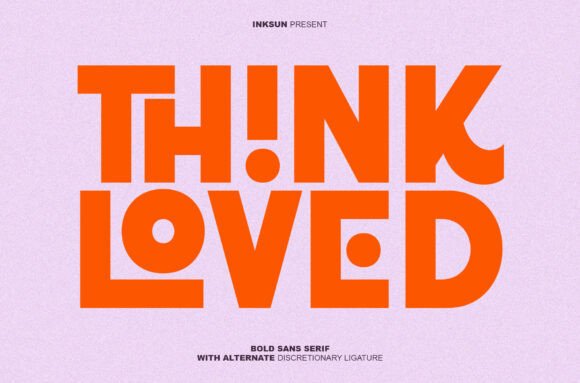
To understand the technical prowess behind Think Loved, one must examine its construction. The font is built upon a rigid geometric grid, which provides a sense of stability and precision. However, what prevents this geometry from feeling sterile or cold are the intentional design interruptions found throughout the character set. The designers have incorporated playful circular cutouts into the letterforms, softening the harsh edges typically associated with ultra-bold typefaces. These circular elements introduce a rhythmic cadence to the text, guiding the eye across the line while adding a touch of whimsy to the overall composition.
Furthermore, the concept of interlocking characters sets this typeface apart from its peers. In traditional typography, letters exist as independent units; in the ecosystem of Think Loved, they are encouraged to interact. This feature allows designers to create ligatures where characters merge seamlessly, turning standard words into bespoke logos or graphic motifs. This level of customization was once reserved for custom hand-lettering, but this font democratizes that capability, allowing a broad audience—from seasoned professionals to enthusiastic hobbyists—to craft unique typographic compositions with relative ease.
The Role of Discretionary Ligatures in Branding
The inclusion of creative alternate discretionary ligatures is perhaps the most technically significant aspect of this typeface. Ligatures, in typographic terms, are specific substitutions where two or more letters are joined into a single glyph to improve readability or aesthetics. While standard ligatures (like 'fi' or 'fl') are functional, discretionary ligatures are purely stylistic. Think Loved leverages this feature to transform standard headlines into striking graphic elements.
For brand strategists and logo designers, this opens up a vast playground of possibilities. Consider a streetwear brand looking to print a collection name on a hoodie. By utilizing the discretionary ligatures in Think Loved, the designer can create a wordmark that looks entirely custom, without the cost and time associated with commissioning a bespoke typeface from scratch. The interlocking nature of these ligatures creates a sense of cohesion and solidity, suggesting that the brand is unified and strong. This is particularly effective in the luxury and fashion sectors, where the visual representation of the brand name is often as important as the product itself.
Practical Applications: From Streetwear to Digital Advertising
The versatility of Think Loved is demonstrated by its effectiveness across vastly different mediums. In the realm of contemporary streetwear, the font’s heavy weight and geometric structure resonate with the culture's appreciation for bold graphics and unapologetic self-expression. It pairs well with oversized silhouettes and minimalist color palettes, allowing the typography to serve as the focal point of the garment. The circular cutouts in the letterforms can also be used to echo other design elements in the collection, such as rivets, buttons, or graphic prints, creating a cohesive visual language.
Shifting to the digital sphere, high-contrast digital advertising presents a different set of challenges that this font addresses effectively. Online spaces are cluttered with information; users scroll through feeds at a rapid pace, often ignoring subtle or understated designs. The ultra-heavy weight of Think Loved ensures that advertisements pop against the background, capturing the user's attention in a split second. Its minimalist shapes ensure that even at small sizes or on low-resolution screens, the text remains legible and impactful. This makes it an ideal choice for hero images, call-to-action buttons, and social media banners where clarity is paramount.
Structural Considerations and Readability
While Think Loved excels in display contexts, it is important to understand its limitations and best-use cases. As a display font, it is optimized for headlines, logos, and short bursts of text rather than long-form body copy. Its ultra-heavy weight and geometric density can make reading paragraphs of text physically taxing for the eye. Therefore, educators and researchers should pair it with a highly legible, lighter-weight sans serif or serif font for body text to maintain a balanced hierarchy.
The minimalist shapes that define the font require careful kerning and tracking adjustments, particularly when used in large formats. Because the characters are designed to be bold and impactful, improper spacing can lead to visual crowding. However, when used correctly, the negative space created by the circular cutouts and the gaps between characters becomes an active part of the design. This interplay between positive and negative space is what gives the font its rhythm and energy, transforming static text into a dynamic visual element.
Designing for the Modern Attention Economy
We live in an era defined by the modern attention economy, where human focus is the scarce commodity that businesses and creators compete for. In this context, design choices are not just artistic preferences; they are tactical decisions. Think Loved is built specifically for this environment. Its aesthetic is not accidental; it is a calculated response to the need for immediate impact. The font does not whisper; it shouts, but it does so with the sophistication of a geometric design system.
For business owners and marketing professionals, adopting a typeface like this signals a brand identity that is confident, modern, and forward-thinking. It moves away from the safe, corporate fonts of the past and embraces a more expressive, human-centric approach to design. By integrating Think Loved into their visual toolkit, creators can ensure that their messaging is not lost in the noise. Whether it is used for a product launch, a promotional campaign, or a rebranding effort, the font provides a robust foundation for communication that demands to be seen.
Integration into Creative Workflows
For creators and designers, the practical integration of a new typeface into existing workflows is a key consideration. Think Loved is designed to be user-friendly, with OpenType features that are accessible in standard design software like Adobe Illustrator, Photoshop, and InDesign. Accessing the creative alternate discretionary ligatures is typically a matter of toggling a setting in the Character panel, allowing for seamless experimentation.
However, the true power of the font is unlocked when it is treated as a design system rather than just a collection of letters. Designers are encouraged to explore the full character set to discover unique combinations and hidden connections between glyphs. For instance, combining specific uppercase letters might reveal interlocking shapes that were not immediately obvious, offering a solution to a complex logo design problem. This exploratory approach aligns with the font's ethos of creativity and impact, turning the act of typesetting into an act of design invention.
Conclusion: A Tool for Visual Storytelling
Ultimately, Think Loved represents more than just a bold sans serif; it is a tool for visual storytelling. Its characteristics—geometric impact, playful circular cutouts, and interlocking characters—provide a vocabulary for expressing ideas that are bold, modern, and unafraid to take up space. As the boundaries between graphic design, fashion, and digital media continue to blur, typefaces that can operate fluidly across these domains become invaluable.
Whether you are a business owner looking to rebrand, a designer working on a new campaign, or a hobbyist exploring the limits of typography, the principles embodied by Think Loved offer a rich source of inspiration. It challenges the conventional wisdom of minimalism, proving that boldness and simplicity can coexist to create something truly memorable. In a world that often favors the quiet and the subtle, there is still a powerful place for the loud, the geometric, and the loved.