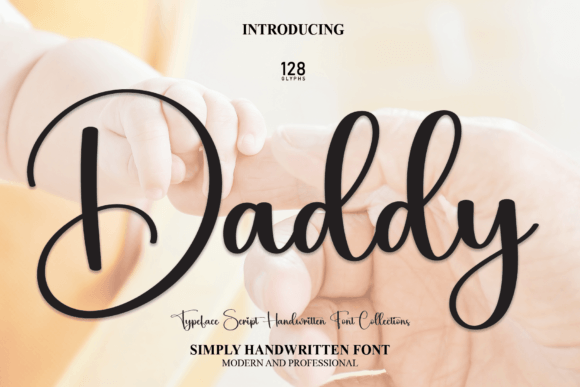
The Art of Connection: Why Handwritten Typography Like Daddy Resonates in Digital Design
In an era defined by algorithmic precision, vector mathematics, and the sterile perfection of screen-rendered pixels, there exists a counter-movement in visual communication that seeks to reclaim the human touch. This movement is not a rejection of technology, but rather an integration of organic warmth into digital frameworks. At the heart of this trend lies typography, specifically the resurgence of script and handwritten styles. Among the vast library of available typefaces, fonts like Daddy represent a specific aesthetic choice: a "lovely and sweet handwritten script" that bridges the gap between personal intimacy and professional scalability.
Understanding the utility of a font like Daddy requires more than just a cursory glance at its glyphs. It demands an exploration of typographic psychology, the mechanics of legibility, and the practical application of decorative text in a crowded marketplace. For designers, educators, and business owners alike, the decision to use a handwritten script is a strategic one, capable of altering the emotional trajectory of a project.
The Psychology of the Handwritten Word
To appreciate the value of the Daddy font, one must first understand why the human eye is drawn to handwriting. In nature, nothing is perfectly symmetrical or mathematically aligned. Our brains are wired to recognize organic patterns. When we see a typeface that mimics the irregularity of a pen stroke—the slight variance in baseline, the changing thickness of the downstroke, and the fluid connection between letters—it triggers a psychological response associated with authenticity and trust.
Standard serif and sans-serif fonts are the workhorses of communication; they deliver information with clarity and authority. However, they often lack soul. A script font like Daddy, characterized by its gentle and romantic flow, introduces an element of storytelling. It suggests that a real person was involved in the creation of the message. This "human element" is crucial for brands and creators looking to foster an emotional connection with their audience. It transforms a generic "Thank You" into a personalized note of gratitude.
Characteristics of the Gentle Script
Fonts in this category, including Daddy, often share specific visual markers that distinguish them from aggressive or formal scripts. They are rarely italicized in the traditional sense; instead, they maintain a vertical or slightly forward-leaning posture that feels natural and relaxed.
- Fluid Connectivity: The letters in a font like Daddy are often connected in a continuous flow, mimicking the act of writing without lifting the pen. This creates a sense of continuity and ease.
- Variable Stroke Width: Unlike monospaced coding fonts, these scripts feature thick and thin lines depending on the direction of the "pen," adding texture and depth to the text.
- Soft Terminals: The ends of the letters (the terminals) are usually rounded and soft, avoiding the harsh cuts found in modern geometric typefaces.
These characteristics make the Daddy font particularly effective for conveying messages that are intended to be joyful, romantic, or deeply personal. It is a visual representation of a whisper rather than a shout.
Strategic Applications in Professional Workflows
While the aesthetic appeal of a font like Daddy is immediate, its practical application requires strategic thought. It is a tool designed for specific contexts. Using a handwritten script for body text in a long report would be disastrous for readability, but using it for a header in a wedding invitation can be transformative.
1. Branding and Identity
For businesses that rely on personal connection—such as bakeries, boutique clothing stores, wedding planners, or lifestyle coaches—the logo is often the first point of contact. A font like Daddy can serve as the primary wordmark or a secondary descriptor to soften the brand image. It signals to the consumer that the business values craft and individual attention over mass production.
2. Event Stationery and Invitations
The most obvious use case for a sweet handwritten script is in the stationery industry. However, the application goes beyond mere aesthetics. In the context of a wedding or a milestone celebration, the typography sets the "tone" of the event. Daddy, with its romantic undertones, promises an atmosphere of warmth and celebration before the guest even arrives.
3. Digital Product Mockups
In the world of e-commerce and digital design, mockups are essential for selling products. Creators selling t-shirt designs, mugs, or tote bags often require fonts that look hand-lettered without the cost of hiring a calligrapher for every variation. A font like Daddy provides the consistency required for production while retaining the irregularity of hand-lettering that customers find appealing.
4. Editorial and Blogging Headers
Bloggers and content creators face the challenge of capturing attention in a split second. Using a script font for article titles or pull quotes can break the monotony of standard web fonts. It acts as a visual palate cleanser, drawing the reader's eye to specific key phrases and adding a layer of editorial sophistication.
Technical Considerations and Legibility
While the Daddy font is described as "lovely and sweet," technical implementation is key to maintaining its effectiveness. One of the most common mistakes in using handwritten fonts is the disregard for legibility, particularly at smaller sizes.
The Hierarchy of Typography
A robust design system utilizes a hierarchy. If the body text is a clean sans-serif (like Helvetica or Roboto), the headers can afford to be expressive. Daddy should almost exclusively be used for display purposes. This includes:
- Headlines
- Sub-headers
- Logo marks
- Short quotes or captions
Attempting to write a full paragraph in a script font like Daddy will result in a "river" of white space and loops that confuse the eye. The brain struggles to distinguish between the loops of an 'e', 'l', or 'o' when they are repeated consecutively in a dense block of text.
Color and Contrast
Because handwritten fonts often have thinner strokes than their bold sans-serif counterparts, color contrast is vital. A light grey Daddy font on a white background may look ethereal in a high-resolution mockup, but it will disappear on a mobile screen or when printed on a standard office printer. Designers must ensure that the "sweetness" of the font does not compromise its visibility. High contrast pairings—such as a dark charcoal script on a cream background—often yield the best results.
Comparing Styles: When to Choose Daddy Over Alternatives
The market for handwritten fonts is saturated. There are brush scripts that look like they were painted with a heavy hand, retro scripts that evoke the 1950s, and grunge scripts that look distressed. Where does a font like Daddy fit within this spectrum?
Daddy occupies the "sweet spot" (pun intended) between casual and formal. It is not as informal as a child’s scrawl, nor is it as rigid as copperplate calligraphy. This versatility makes it an excellent choice for creators who want to add a romantic touch without alienating a professional audience.
- vs. Brush Scripts: Brush scripts are often energetic and bold, suitable for sports or food branding. Daddy is gentler and more subdued, making it better for beauty, wellness, and lifestyle sectors.
- vs. Serif Fonts: While a serif font suggests history and authority, a script font like Daddy suggests intimacy and approachability.
- vs. Sans-Serif Fonts: Sans-serifs are utilitarian. Daddy is decorative. They are natural partners in a design layout, where the sans-serif does the heavy lifting and the script provides the flair.
Implementation Across Media
The utility of a font extends across various media types. A font that looks great on a website might fail in print, and vice versa. The Daddy font, being a digital representation of handwriting, generally translates well across vectors, but there are nuances to consider.
Web Design and CSS
When integrating Daddy into a web project via CSS (using @font-face or a service like Google Fonts), developers must pay attention to font-kerning and letter-spacing. Handwritten fonts often have default spacing that feels too tight or too loose when rendered in browsers. Tweaking the letter-spacing by a pixel or two can significantly improve the reading flow.
Furthermore, accessibility is paramount. Screen readers generally handle these fonts well, provided the text is actual text and not an image. However, designers must ensure that the font size is sufficient for users with visual impairments. A minimum of 24px is recommended for script headers to maintain clarity.
Print Production
In the realm of physical goods—such as wedding invitations, greeting cards, or packaging—the Daddy font requires careful handling during the pre-press process. Very thin strokes can sometimes "break" or disappear in offset printing, particularly on textured paper stocks. It is advisable to test print a sample to ensure the "sweetness" of the line work is preserved on the chosen material.
The Future of Organic Typography
As we move further into the age of AI and automation, the demand for "human" elements in design is likely to increase. We are seeing a trend where luxury brands are stripping away the sterile minimalism of the 2010s and reintroducing texture, warmth, and imperfection.
A font like Daddy is not just a file on a computer; it is a response to a cultural desire for connection. It allows a digital business to mimic the warmth of a handwritten letter from a friend. For educators creating worksheets, it adds a friendly, approachable face to learning materials. For researchers presenting data, it can soften the blow of complex statistics when used in slide deck titles.
Conclusion: The Enduring Appeal of the Script
The Daddy font exemplifies the power of typographic personality. It is a tool that, when used with intention, can elevate a project from merely informative to emotionally resonant. By understanding its characteristics—its gentle flow, its romantic connotations, and its technical requirements—creators across all industries can harness its potential.
Whether you are designing a logo for a new startup, crafting a digital invitation, or simply looking to add a touch of joy to a presentation, the inclusion of a sweet handwritten script serves as a reminder that behind every pixel, there is a human story waiting to be told. It is a celebration of the imperfect, the personal, and the beautiful.